
Debt Collection in Spain
- Risk-free. Pay only upon success.
- 9,5 % in commission.
- Debt collection conducted locally in Spain.

 An international collection agency that is rated 9,4 out of 10 based on 72 reviews on Kiyoh!
Effective debt recovery in Spain
Are you looking for a debt collection service in Spain because a Spanish customer has not paid your invoice? By using Oddcoll, a Spanish law firm can start working on the recovery of your debt today. Read on to see how it works.
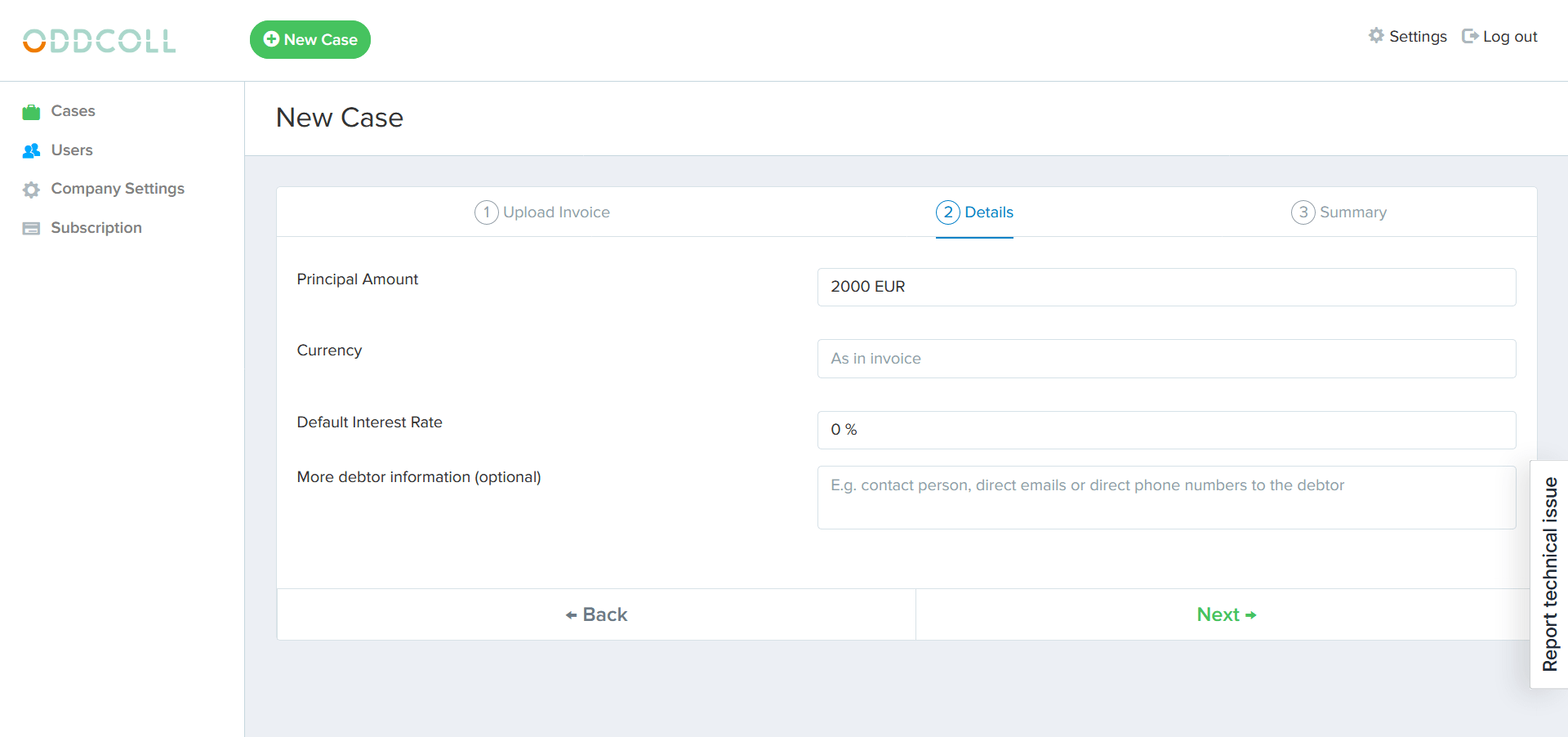
Three steps to get paid by your Spanish customer!
Create a case on our debt collection platform by uploading your unpaid Spanish claim.
Our Spanish law firm will start, locally in Spain, to initiate the appropriate collection actions against your debtor.
When a payment is made by the debtor, the money is transferred directly to your chosen bank account.
A few reasons to use Oddcoll for debt collection in Spain.
A Spanish law firm working on your Spanish debt collection case.
Spanish-speaking specialists.
Experts on Spanish legislation and business culture.
Our approach!
Debt collection against debtors in other countries can be complicated and time-consuming. To make it easier for international creditors, we have created a debt collection platform with the best national debt collection agencies and law firms around the world.
This includes Spain where we have a local Spanish law firm, with unrivalled experience and expertise in how to get debtors located in Spain to pay.
Our local Law Firm in Spain.
With regard to payment practices in Spain, Spanish companies, in an International comparison, are slow with their B2B payments. And when you cannot get your Spanish customer to pay, you should quickly get help from a Spanish debt collection company. An expert in getting Spanish debtors to pay.
In Spain, our local debt collection partner is Cobro Ágil, located in Madrid, Spain. They will start working on your Spanish debt collection cases as soon as you start them on our debt collection platform.
– Could you briefly describe your company?
Cobro Ágil is constituted as a firm belonging to the law firm Alter Lex Abogados y Asesores, S.L., within which all types of recoveries of claims are managed, made up of highly qualified professionals specialized in the matter.
– Can you give us an overview of the collection process in Spain / What actions are you taking in the friendly stage of debt collection?
At Cobro Agil we process all phases of the debt claim process, from the first contact with the debtor to the friendly and judicial procedures, ending with execution and seizure, if necessary.
The extrajudicial claim begins with a preliminary study of the debtor, his situation and his solvency. Later we try to locate and contact him, by telephone and by sending payment requests signed by our lawyers. In this out-of-court phase, an attempt is made to offer possibilities for deferred payment and debt recognition agreements.
– How does it work in Spain when you need to take legal action?
If the extrajudicial claim is not satisfactory, we initiate the judicial process, normally filing an order for payment procedure. For this we need power of attorney and it entails expenses of court taxes and procurator´s fees. The lawyer´s fees are assumed by Cobro Ágil.
When the debtor receives the request for payment, he can do 3 things: pay, oppose the claim, for which he needs a lawyer and attorney or do nothing.
In the latter case, we will have to file another demand for ordinary procedure, if the debt is greater than 6000 euros and if it is less, initiate execution and seizure of the debtor’s assets.
– If you are taking legal action in a case and you win in court, can the costs of the legal actions that the client paid be added to the debt?
In all legal proceedings we request that the costs be awarded, that is, that the debtor pay the costs of the procedure (up to 30% more than the claimed debt).
“Judicial” debt collection in Spain.
Going to court in Spain with a debt collection case.
The main rule for civil suits in Spain (i.e. a dispute between two private parties) is that the debtor must be sued before the court of first instance in the area where the debtor is domiciled.
In the case of a dispute against a legal person (organisation or company), a writ of summons may also be filed in the court of the place where the contractual obligation would have, or has occurred (if the defendant carries on business in that place or has some representative there.) However, it is up to the creditor to choose the forum in these situations.
Do you need a legal representative?
Yes, as a general rule, to initiate a Spanish debt collection case in court, you need; a “procurador”, and a legal representative. However, there are exceptions to this where the claim does not exceed €2,000, or when the order for payment process is used.
Who do I contact to start a case?
An application is made to the Court Registry of the court that has jurisdiction over the case.
What languages can be used in Spanish court proceedings.
Spanish is the official language, but in regions with local languages, these can also be used.
Does it cost any money to take legal action in Spain?
It does not cost anything for natural persons, but legal persons have to pay a court fee in order to take a civil case to court.
The “order for payment” process in Spain.
There is a Spanish legal procedure that is perfectly suited for “judicial” debt collection in Spain, and is designed to speed up and simplify the legal process in specific simple and straightforward cases. The procedure is called an “order for payment”.
The special feature of this procedure, as opposed to suing someone in the ordinary civil procedure, is that the court does not examine the accuracy of the claim. This means that unless the defendant objects to the claim, the court can issue a judgment without going into the merits of the case.
Should a debtor object to the claim and argue that it is not correct, the debtor can contest the claim in the order for payment. In such a case, the creditor must proceed with the ordinary civil procedure where the matter is examined on the merits by the court.
Should the claim not be contested by the debtor, the court can issue an enforcement order. It serves as legal proof of the existence of the claim. The “enforcement order” can then be used in an application for enforcement.
Can the order for payment process be used for all debt collection cases in Spain? There is no limit on the amount of the claim. The order for payment procedure can therefore be used for claims of any size. However, the procedure is optional and a creditor can choose to use the ordinary civil procedures instead. The competent court is the same as for ordinary legal proceedings.
What needs to be included in the application? What needs to be included in an application for an order for payment is information about the debtor and the creditor, the amount of the claim and a brief description of how the claim arose.
Application for enforcement in a Spanish debt collection case.
The meaning of applying for enforcement in the Spanish debt collection process is that a creditor enlists the help of the Spanish authorities. The Spanish authorities intervene compulsorily to transfer assets from the debtor to the creditor.
Of course, the authorities are not supposed to easily enter and dispose of the subject’s assets, so the prerequisite for enforcement is therefore the existence of an “enforcement order” demonstrating that there is in fact a debt to be paid. In the context of debt collection in Spain, an enforcement order usually consists of a judgment from the ordinary court proceedings, or alternatively a judgment from the order for payment process.
An application for enforcement is made to the court that issued the judgment. Thus, it is usually the court of first instance where the debtor is located.
Insolvency proceedings in Spain.
As a small separate branch from the rest of the debt collection process in Spain, we can also briefly mention insolvency proceedings. These are situations where a Spanish debtor is actually unable to repay all his debts.
The courts are responsible for insolvency proceedings and are assisted in the management of bankruptcy estates by so-called liquidators. The liquidator takes care of the day-to-day management of the bankrupt’s estate and compiles lists of assets and debts. The aim is to ensure that all creditors are treated as fairly as possible on the basis of the assets remaining in the bankrupt’s estate.
When you need help with debt collection in Spain, Oddcoll can help. Contact us if you have any questions. Do you want to get started with the recovery of your Spanish case right away? Then start a case and our Spanish law firm will begin the collection process in Spain.