
Debt Collection in Greece
- Debt collection in Greece conducted locally.
- Risk-free. Pay only upon success.
- 9,5 % in commission.

 An international collection agency that is rated 9,4 out of 10 based on 72 reviews on Kiyoh!
Debt collection in Greece through a Greek law firm.
Do you have a problem with a non-paying Greek customer? We can help you with debt collection in Greece. In just a few minutes, a law firm in Greece can start working on your debt collection case. Read on to see how it works.
Get paid for your Greek debt.
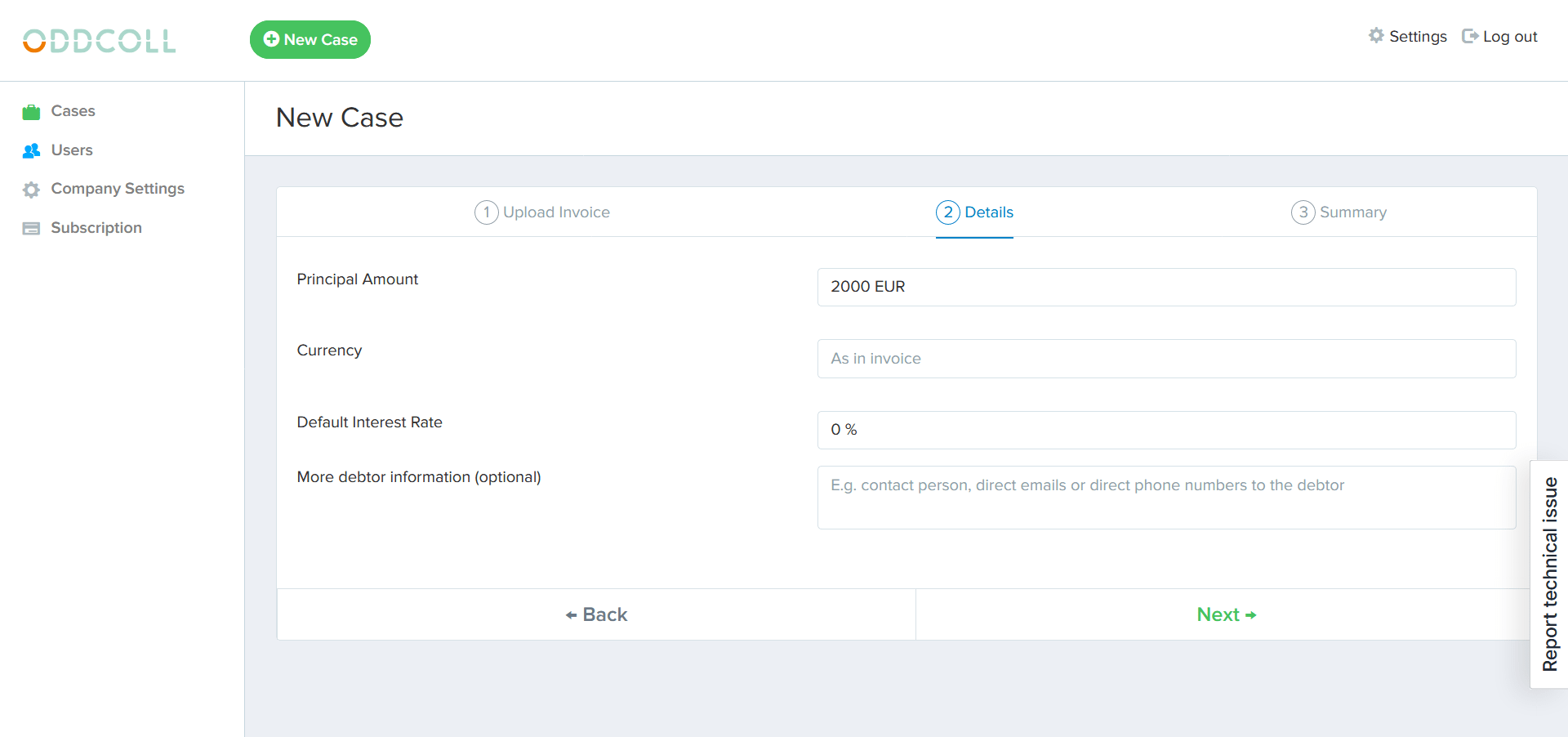
Start the case by uploading your unpaid Greek invoice.
Our Greek law firm will start the debt collection process in Greece.
When the debtor has paid, the money is transferred to you.
Why should you use Oddcoll for debt collection in Greece?
A law firm on the ground in Greece working on your case.
You only pay if any money is actually recovered.
Get started with your case quickly and easily on our web portal.
Avoid the frustration of unpaid foreign invoices.
At Oddcoll, we are well aware of how frustrating it can be when a customer from another country delays payment. If you are not in the same country as the debtor, you have no leverage against your debtor. We’ve fixed that with an international debt collection platform connected to the best national debt collection agencies and law firms around the world. This means that for debt collection in Greece, our Greek law firm will work on your case. This puts a lot more pressure on the debtor.
Our law firm in Greece.
As national Greek laws and regulations apply to debt collection practices in Greece, you must find a Greek Debt Collector to increase your chances of successful collection of your claim. In Greece, our partner is KPAG Kosmidis & Partners Law Firm, in Angelohori. They will handle the recovery of your case as soon as you upload the unpaid invoice.
Could you briefly describe your company?
“KPAG Kosmidis and Partners” is an international and cross-border acting law firm, offering a wide variety of services for companies and private clients. Our services for business clients include commercial and corporate law, business consultancy, debt recovery, business litigation and legal enforcement.
Can you give us an overview of the collection process in Greece/ What actions are you taking in the amicable stage of debt collection?
We approach each case carefully and choose the fastest and most cost-effective way to secure debt recovery. Sometimes a few phone calls or a written demand of payment addressed to the debtor by First Class recorded delivery post, will suffice. In other cases, the demand of payment is served by a clerk, so that the debtor realizes the seriousness of the issue.
Prior to preparing the letter, we may obtain business information and profile report on the debtor, in order to have a better understanding of the debtor’s financial situation which would enable us to select the most suitable method to handle the account and inform our client accordingly.
If the debtor cooperates, we consider possible solutions, which include a mutually agreed payment plan and negotiations about any disputed matter. If such extrajudicial actions fail, only then do we consider legal actions, choosing the appropriate remedy.
How does it work in Greece when you need to take legal action?
Based on the facts and surrounding circumstance of each case, we present to the client the proposed legal path to be followed for the case at hand.
We ensure that all the client’s enquiries are fully clarified so that the latter takes the most suitable decision.
Subsequently, we support and represent the client at every stage of the litigation proceedings, nationwide and before all Courts, from First Instance to the Supreme Court.
If you are taking legal actions in a case and you win in court, can the costs for legal actions that the client has paid for be added to the debt?
In principle, Greek Courts attribute a certain amount of legal costs to the winning party of a legal dispute. However, such amount is usually nominal and does not always correspond to the exact amount of legal expenses paid by the litigant.
“Judicial” debt collection in Greece.
Our Greek law firm will of course do everything it can to collect your invoice without having to take any legal action against your Greek debtor. However, sometimes it becomes a necessary step in the Greek debt collection process to take legal action against a debtor. Below is a brief explanation of the legal framework should this be the case.
Going to court with a debt collection case in Greece.
In order to determine which Greek court a creditor should turn to for his Greek debt collection claim, the first step is to find out which region the debtor belongs to. As a general rule, the court where the debtor is domiciled is the one that should hear the case.
The next step is to find out which specific court in the territory is the right one to turn to.
Almost always, the size of the claim determines which court is competent to hear the case.
There are essentially three different courts that hear a Greek debt collection case. (i.e. a civil dispute about a claim, between two parties.)
- The small claims courts (Irinodikia)
This court handles disputes on claims up to EUR 20 000.
- (Monomeli Protodikia)
This court handles disputes for claims ranging from EUR 20 000 to EUR 250 000.
- (Polymeli Protodikia).
This court deals with disputes for claims of more than EUR 250 000.
An application for a writ of summons to a Greek court must be in Greek and, as a rule, in writing.
The “order for payment” procedure in Greece.
As a good alternative for legal debt collection in Greece, creditors can choose to use the order for payment procedure.
This is a legal process that most countries have their own version of.
The background to the procedure is this: Many cases that come to court are cases where the debtor does not necessarily contest the claim. But the claimant still goes to court because the defendant does not pay.
In order not to take up too much of the judges’ time in these cases, a special procedure has been created for cases where the debtor has not contested the claim. The procedure is intended to be quicker, simpler and cheaper than suing a debtor under the ordinary rules of civil procedure. It is therefore an option that benefits both creditors and society as a whole.
What are the conditions for using the order for payment procedure? It must be a claim for money of a certain amount. There is no upper limit and the procedure is voluntary for the creditor.
An application must contain:
- Details of the parties to the dispute.
- Details of the claim. (its amount, due date)
- Details of the basis of the claim. I.e. why does the debtor owe the creditor money.
- Written evidence. Such as contracts or other evidence of the existence of the debt.
If everything in the application is in order, the debtor must be served with the order for payment. The debtor then has 15 days to decide whether they wish to contest the claim. If a challenge is not made, the order for payment needs to be served on the debtor at second time, giving te debtor a second chance to consider the claim. The debtor then has ten working days to contest the claim. If this is not done, the order for payment is enforceable. This means that the claimant can use it in an enforcement procedure against the debtor.
if the debtor chooses to contest the order for payment, the court will consider the challenge and whether the order for payment process should be discontinued.
The enforcement of a Greek claim.
If you have taken legal action in the process of debt collection in Greece and obtained either a judgment or an enforcement order through the order for payment, what is the next step?
Hopefully, the debtor will then comply and pay what it owes. But should the debtor still fail to pay, the next step in the Greek debt collection process is to apply for enforcement.
If the debtor has assets in Greece, the Greek state apparatus can help to ensure that assets are transferred from the debtor to the creditor. This is a coercive intervention and that is why an enforcement order is required for the authorities to carry it out.
Insolvency proceedings in Greece.
An alternative scenario in the Greek debt collection process is that insolvency proceedings are sometimes initiated. These are situations when Greek debtors no longer have the financial muscle to pay their claims. They are in insolvency, and these are not temporary payment problems.
Insolvency proceedings may, under certain conditions, be initiated either by the debtor himself, by a creditor with a claim against the debtor and, in certain cases, by a public prosecutor if there is a public interest in the debtor’s being declared bankrupt. An application is sent to the court of first instance.
A debtor loses control of its assets during insolvency proceedings. Instead, an administrator (“sýndikos”) becomes responsible for the operation of the debtor’s assets.
The outcome of the insolvency process may be the liquidation of the company. Lists of the company’s assets and liabilities are then created and creditors are compensated as fairly as possible for their claims by the bankruptcy estate.
Sometimes the outcome can also be a reorganisation plan in which the claims are written down in agreement with the creditors. In these cases, the company can sometimes continue to operate.
Do you need help with debt collection in Greece? Oddcoll can help you through our local Greek law firm. Just upload your invoice to get started. Contact us if you have any questions.
See how easy it is to get started with your case!