
Debt Collection in Belgium
- Debt collection in Belgium conducted locally.
- Risk-free. Pay only upon success.
- 9,5 % in commission.

 An international collection agency that is rated 9,4 out of 10 based on 72 reviews on Kiyoh!
Debt recovery services in Belgium
Is your company having a hard time collecting its debt in Belgium because your customers in Belgium are not willing to pay the debt? Our professional debt collection agency in Belgium are always here to help you. The instant payment of your invoices is our job. If you intend to hire a firm for debt collection in Belgium, read out the services we offer.
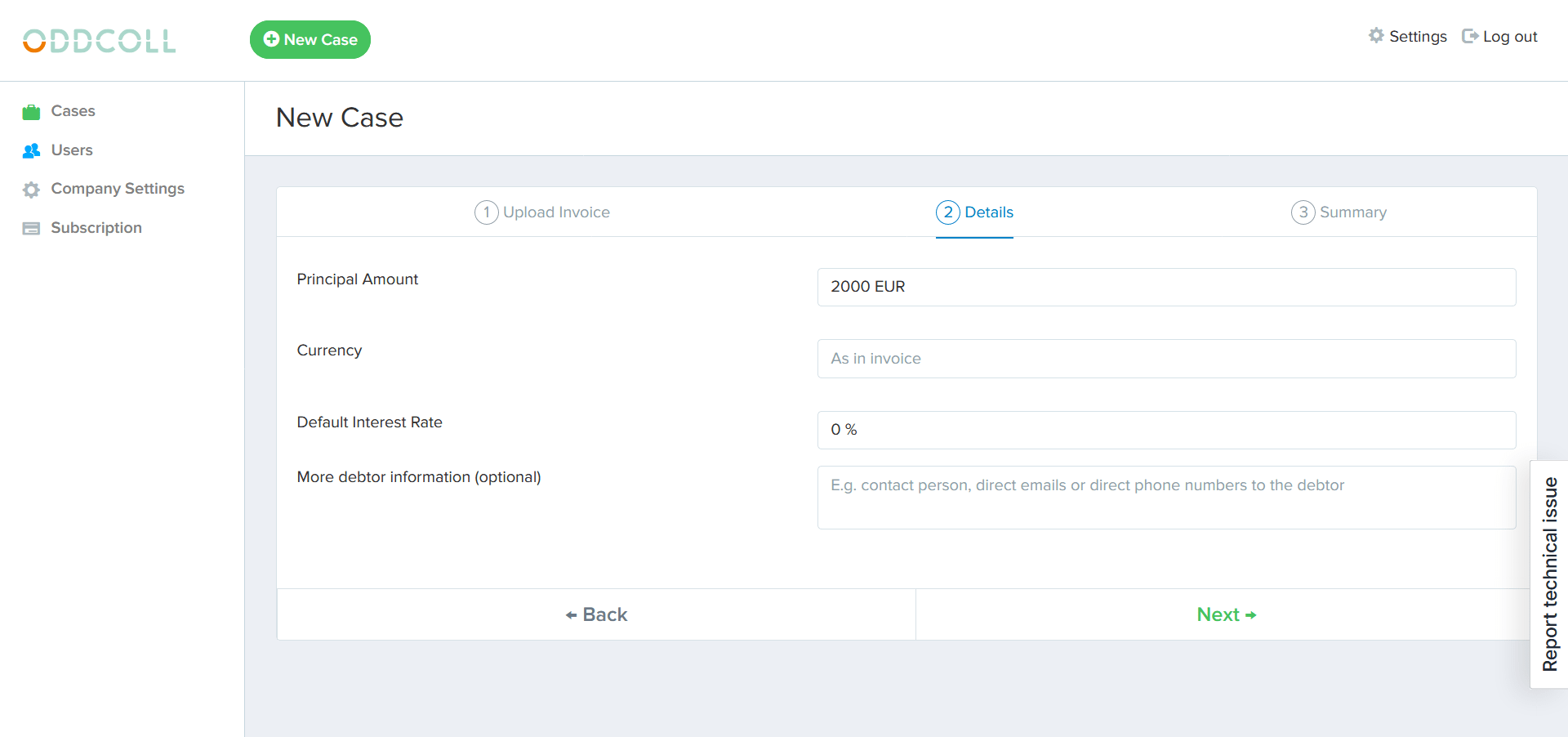
Three steps to get paid for your Belgian invoice.
Upload your unpaid Belgian invoice.
Our Belgian debt collection agency starts the debt collection process directly in Belgium
The money is transferred directly to you.
Why you should use Oddcoll for debt collection in Belgium
Our Belgian debt collection partner carry legal authority wich affects the debtor’s willingness to pay.
Our debt recovery in Belgium is carried out locally on site.
“No win no fee”. You only pay if we are successful.
Experts in Belgian debt recovery legislation.
We make it easy for you to get paid from your belgian customers.
Oddcoll is a platform with hand-picked debt collection agencies and law firms worldwide. We make debt collection in Belgium easy through our local expertise and risk-free approach.
Just upload your unpaid Belgian claim to us to get started. The price is set at a total of 9.5 in commission for the amount collected. If no money is recovered, you pay nothing.
Our experience with numerous debt collection firms in Belgium indicates that VP Consulting BVBA is the best among all. This agency has the highest recovery rate and excellent feedback from its customers. Since all our recovery cases in Belgium are now managed by VP Consulting BVBA, we ensure that you are using the best Belgian debt recovery firm to maximize your chances for payment.
Our debt collection agency in Belgium.
Belgian legislation and rules that are unique to Belgium govern the entire debt collection process.
Therefore, you must use a Belgian debt collection agency to get your debtor to pay.
When you upload your invoice to Oddcoll, our local partner (an experienced Belgian Debt Collection Agency) starts to collect your claim.
Our Belgian Partner is the Debt Collection Agency VP Consulting.
With about 500 customers and 2.000 cases each month for 1.500.000 euro. And a success rate of 90 %.
Could you shortly describe your company?
VP Consulting is a small custom made Belgian debt recovery agency that collects consumer and commercial claims for all types of services and industries. We are a proud member of the Belgian Collectors Association. So we are following Their code of conduct. To become member, a debt recovery agency has to:
– Be incorporated, subject to a legal obligation to publish its annual accounts and to be registered in the Central Company Databank. It must have a company identification number and be listed with the Federal Public Service for Economy as being a debt collector.
– Have carried on debt collection activities for at least 3 years.
What challenges do you face with debt recovery in Belgium?
The Belgian law stipulates that B2C (consumers) claims have a special treatment. We need to wait 15 days before starting a new action. So if we send a reminder to the debtor and we have no result we have to wait minimum 15 days before to start a legal action. For B2B (business) we don’t have to wait 15 days. So no obligations to apply a minimum period.
If you are taking legal actions in a case and you win in court, can the costs for legal actions that the client has paid for be added to the debt?
When we start up a legal action in Belgium we always analyze the case at the bailiff. If the debtor’s solvency is not OK we will usually suggest to to resolve the case “amicably”. This is to avoid high legal costs.
“Judicial” debt collection in Belgium.
It is not always that amicable action is enough for debt collection in Belgium. Sometimes it may be necessary to proceed legally in the case.
Which court deals with debt recovery cases in Belgium?
The country is legally distributed into different areas (divisions, districts, etc.). Each court can decide the cases only in a certain area. This is called territorial jurisdiction.
The freedom given to the applicant to select the court of his choice is the fundamental principle in the legal system here—article 624 (I) of the Judicial book safeguards this provision. Mostly, the cases are brought before the judge of that area court where anyone among the defendants has his address registered (woonplaats/domicile).
But what if the defendant is a company? Then the address will be that the registered head office (hoofdzetel/siège).
To file a case in a specific court, the individual has to register it in the registry of that court or the reception office. The option of filing a case by email or fax is currently not available.
Which language is most suitable for my petition?
As far as the selection of language is concerned in a court, the act passed on 15 June 1935 for the selection of legal language in courts can be referred (wet van 15 juni 1935 betreffende de taalkeuze in gerechtelijke zaken) (printed on 22 June 1935 in the Belgisch Staatsblad/ Moniteur belge). The direction for the use of language in the Belgian business and civilian courts is found in this act.
Principally, the area in which the court is situated decides the language. In Section 42 of the above-mentioned Act, three language-based regions are mentioned: the German, the French, and the Dutch areas. A vast bilingual region of Brussels (Dutch/French) is also present for filing legal cases. And the following localities are included in it: Auderghem, Anderlecht, Brussels, Berchem-Sainte-Agathe, Evere, Etterbeek, Ganshoren, Forest, Jette, Koekelberg, Ixelles, Molenbeek-Saint-Jean, Saint-Josse-ten-Noode, Schaerbeek, Saint-Gilles, Uccle, Woluwé-Saint-Pierre, Watermael-Boitsfort, and Woluwé-Saint-Lambert.
However, in special circumstances, a case can be filed in a court in a different language. Before starting the proceedings of any case, the change of language can also be requested, but in special conditions only.
Is a legal fee to be paid for debt recovery cases in the Belgium court?
Some charges are definitely to be paid to the courts for legal debt collection in Belgium.
When the case application is submitted, the individual has to pay a fee mentioned in Section 4(2) of the 19 March 2017 Act, which is submitted in the legal budget fund for special cases (Wet van 19 maart 2017 tot oprichting van een begrotingsfonds als juridische ereloon in de tweede graad), which is €20 at the time of writing.
As the case goes on, both the parties pay some charges linked with the case, and this is dependent on the process defined by the judge (travel charges, investigative charges, fees paid to experts, etc.).
As the case reaches its end, the judge orders the defeated party, or in its absence, the filer to pay the charges, and this amount is different for every case.
Using an “order for payment” in Belgium to collect your debt.
A payment order is a simplified legal process for belgian debt collection claims that has not been contested. An executive order for the procedure of payment is present in Belgium (procédure sommaire d’injonction de payer, d.w.z. overzicht van acties om betaling te vragen). This process is elaborated in the Section 1338 to 1344 of the Judicial book and its main objective is to recover payments in specific cases.
- Only monetary claims are applicable.
- The Judicial Code Article 1338 says that only claims for the recovery of debt not above €1860 are permitted.
- The selection of executive orders for the process of payment is optional.
The judge of peace can permit the usage of this procedure (juge de paix / rechter voor vrede), only if the matter is in the jurisdiction of the court. For the cases mentioned in the Judicial Code Article 1338, the above-mentioned process can also be availed for all the cases that fall in the domain of the commercial judge (handelsrechtbank / handelsrechter) or the police judge (tribunal de politie / politierechter).
Before filing the case in court, the creditor must formally request the debtor for the payment (sommatie van de betaler / betalingswaarschuwing). This is mandatory according to the Judicial Code Article 1339. The payment request can be sent via a legal officer to the debtor (huissier de justice / juridisch medewerker) or via some registered courier along with the confirmation of receipt. The same article also specifies that the details for the payment of debt must also be legally verified, as said:
After the 15-day expiry of the request, the case is registered in the court via an application along with a copy of the request. The Judicial Code Article 1340 mentions that the application must have:
Complete information must be present in the application. Subpara 3 of paragraph 1 of the Judicial Code Article 1340 demands the applicant to mention the measures taken till filing the case. The details about the amount of payment, with the relevant items that serve as part of the claim, and also the legal basis of the claim must be specified in the application.
Article 1338 says that the legal claim must be supported by a formal document that is published by the debtor. However, there is no need for acknowledgment of payment in that document.
If the debtor disputes:
There are two methods for the debtor to object to the “order for payment”; by making an appeal in the higher judicial court or by raising a legal objection in front of the same judge who has passed the “payment order” (since the order of the judge is just like a final decision in its structure) In either case, the expiration date is not more than a month from the date of publication of the order (read the Judicial Code Article 1051 and 1048). This date can be extended in case either of the two parties is not having a registered residence or address (domicilie élu / geselecteerde woonplaats) in Belgium.
All the general rules are applicable on appeal and Objection, except in one case, which is mentioned in the Judicial Code second subpart of Article 1343(3): by avoiding Article 1047 (which demands the hiring of a bailiff), an objection can be raised by filing an application at the registry of the court, with as many copies of the application as much the lawyers and parties, which is then forwarded by the court clerk to the creditor and his legal team via a special letter issued by the court.
If the defending party objects, both parties are summoned by the court to a court hearing.
The execution of the court order in Belgium:
If the debtor is not complying with the court ruling, the creditor can ask the courts for enforced implementation. This demands a legal enforcable title (Judicial Code Article 1386) since the private domain of the debtor is to be intruded on now. This legal title can be a court decision. In respect of the debtor’s private life, the legal title may not be applied at specific times (Judicial Code Article 1387). The bailiff implements the Enforcement.
If you are looking for debt collection in Belgium, Oddcoll can help you in a quick, easy and efficient way. Fill in the form and we will contact you within 24 hours.
See how easy it is to get started with your case!