
Debt Collection Hungary
- Risk-free. Pay only upon success.
- 9,5 % in commission.
- Debt collection Hungary – Conducted locally.

 An international collection agency that is rated 9,4 out of 10 based on 72 reviews on Kiyoh!
Debt collection for your claims against Hungarian debtors.
There is an easy way to get paid for your overdue Hungarian invoices. Read on to find out how you can easily use our collection specialists to collect debts against debtors in Hungary.
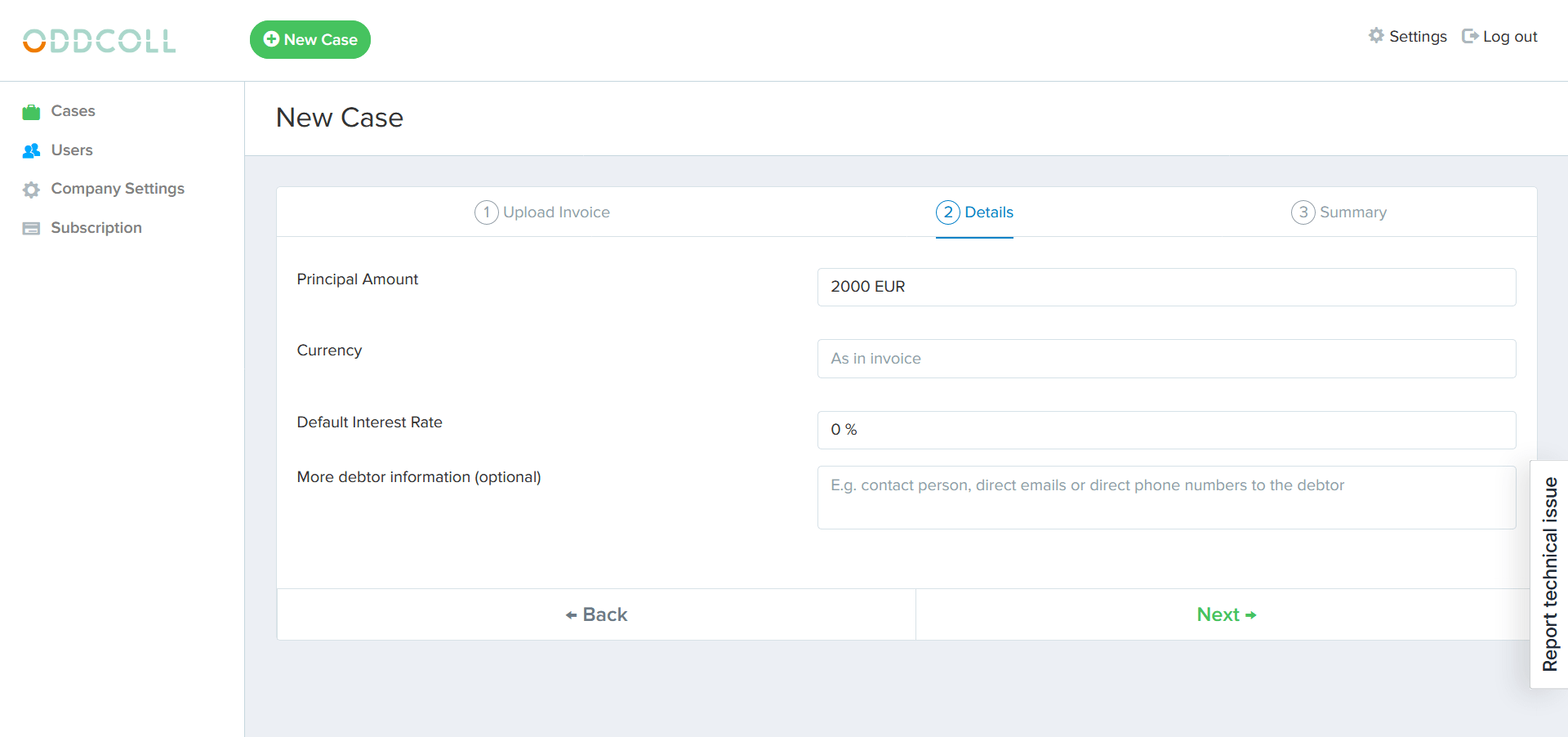
The debt recovery process in three simple steps.
1, Create your case for debt collection against your Hungarian debtor on our debt collection platform.
2, In Hungary, our local Hungarian specialist will start the collection process.
3, Once they have succeeded in getting the debtor to pay, the money is transferred directly to you.
Why you should use Oddcoll’s debt collection services in Hungary.
A local Hungarian service that collects the debts for your business.
Speaks Hungarian with your debtors.
A professional collection process from amicable collection to legal proceedings in the hungarian court.
Specilists on Hungarian processes and rules.
How Oddcoll help you collecting debts against debtors in Hungary!
We help companies with debt collection services and to get paid for their foreign receivables.
We do this through an international debt collection platform that has assembled quality-assured national debt collection agencies and law firms around the world.
This means that whenever you need help against debtors in Hungary, you can start your case in a minute and our Hungarian debt collector will start actions to get your debtor to pay.
All you need to know about international debt collection in 50 sec.
Our local debt collection agency in Hungary.

We are happy to present our debt collection agency in Hungary; Credit Control KFT.
Here is a presentation from our partner in Hungary:
Our company has been active in the field of receivables management for almost 20 years. We also deal with B2B and B2C. We also have extensive experience in the extrajudicial recovery of utility, telecommunications and bank debts. We also handle claims arising from corporate transactions. In addition to receivables management, we also have our own business information system. As part of our claims management service, we always check the debtor companies to ensure that they are not subject to any pending proceedings (liquidation, bankruptcy, winding-up) that may render the claim unenforceable. In all cases, we will inform our partners if we become aware of any factor that negatively affects or prevents our process.
The out-of-court claims procedure consists of the following steps. Within 1-3 working days of the case being confirmed, we will send the debtor a letter of formal notice in accordance with the substantive and formal requirements laid down by law. If necessary, we will send the letter by registered letter, but this is usually only done for capital debts of HUF 200 000 or more. After sending the letter, we wait 1 week to see if the debtor responds to our letter. If the debtor does not respond and we have telephone contact details, we will try to contact the debtor by phone.If the creditor does not provide telephone contact details with the order, only public databases are available to find a debtor’s telephone number. In all cases, if we are unsuccessful and a mobile phone number is provided, we will also contact the debtor by SMS. If an email address is available, we will also try to contact the debtor via this address. If contact is unsuccessful, we contact debtors on a weekly basis. We will send another reminder letter 45 days after the first letter if our enquiries do not lead to a result. For individual, high-value cases, we also send a third, final notice, giving a short deadline for settling the debt and indicating the fact that legal proceedings may be initiated. Our case handling time is usually 90 days, and if we are unsuccessful within this time, we will close the case and propose legal action.
In the case of a private individual, an order for payment procedure can be started against the debtor. If the debtor objects within 15 days of receiving the notice, the case can be taken to court. If the debtor does not object and the order for payment becomes final, enforcement proceedings can be started. This is also the default procedure for corporate debtors. However, if the amount of the capital debt exceeds HUF 200 000 and the debt has not been contested by the debtor in accordance with the bankruptcy law, liquidation proceedings can be opened against the debtor company.
Information about debt collection in Hungary.
Below is a brief review of the process, procedures and the law regarding recovering debts in Hungary.
We will go through the debt collection process in Hungary. From the rules in the “friendly” stage, to the enforcement of a judgment and insolvency proceedings.
The process flow looks like this:
Amicable debt recovery in Hungary –>
In-court procedures –>
Enforcement of judgments in Hungary.
 “Amicable” debt recovery in Hungary.
 “Amicable” debt recovery in Hungary.
The starting point of the collection process against Hungarian debtors is the extrajudicial stage.
This means that a Hungarian debt collection agency uses its knowledge and expertise to persuade the debtor to pay the debt without having to go to court.
To be successful in this, the debt collector needs to have a good knowledge of the current laws, business climate and to be skilled in dealing with and persuading debtors. A good picture of the debtor’s financial situation is often required. Tools used at this stage of the debt collection process in Hungary are often demand letters, telephone calls and email correspondence.
“In-court” debt recovery in Hungary
 “In-court” debt recovery in Hungary
Should a Hungarian debtor, despite action at the extrajudicial stage of debt collection in Hungary, continue to default on payment, legal action may have to be taken against the debtor.
Which court should I turn to? In Hungary, there are two types of courts that hear civil cases at first instance. These are the General courts (törvényszékek), and the District courts (járásbíróságok). General courts (törvényszékek) have jurisdiction by law for certain types of legal matters for example such as copyright cases. For all other cases, where the General Courts do not have a specific jurisdiction by law, the District Courts (járásbíróságok), are the relevant ones to use. This means that for legal debt collection cases in Hungary, this is the court that will be most often relevant to the case.
The application for a writ of summons must be submitted directly to the court having jurisdiction and competence to hear the case.
For cases against natural persons, this means that the court of the defendant’s domicile has jurisdiction in all cases where no other court has exclusive jurisdiction. For cases against companies, the place where the company has its seat, or where the body representing the legal person has its seat. In case of doubt, the place of business shall be regarded as the seat.
Court fees: in Hungary, as in other countries, going to court with your debt collection case entails certain costs. It is the creditor who has to pay the fees when the application is filed. The amount varies from case to case.
Order for payment in Hungary:
A special legal procedure in Hungary that is particularly suitable for “legal” debt collection in Hungary is “Order for payment”.
It is a simplified legal procedure designed to allow a creditor to take an uncontested monetary claim to court, but avoid the expensive, slower process of ordinary civil litigation. The procedure does not fall within the competence of the court, but rather within that of the judicial notaries. However, an order for payment decision has the same legal effect as a judgment.
The procedure is particularly suitable for judicial debt collection in Hungary, as it is intended to be used for uncontested claims. The idea is that if the debtor does not contest the claim, an enforceable order for payment can be issued. This saves a lot of work for the ordinary courts, as they do not have to get involved in uncontested cases.
There is an upper limit on the amount of the procedure, which is HUF 30 000 000. For larger claims, the ordinary civil court procedure needs to be used. For claims below HUF 3 000 000 the procedure is compulsory. In all other cases it is optional.
The order for payment procedure: no evidence is required when applying for an order for payment against a Hungarian debtor.
However, the application should contain a brief statement of the facts underlying the claim and an indication of the supporting evidence.
What happens if the debtor disputes that he does not owe money at all? The debtor can lodge an objection to the order for payment with the notary within 15 days of being served with the order. If an objection is lodged within the time limit, the case will be transferred to ordinary civil proceedings.
If an order for payment is not objected within the time limit, it has the same effect as a final court judgment.
Enforcement of judgments in Hungary:
Enforcement proceedings in Hungary can be started when there is a judgment or other enforcement order (such as the order for payment) against the debtor, but when the debtor still does not pay his debt.
As a creditor, you can then apply for enforcement and get help from the authorities to transfer assets from the debtor. The application for enforcement must generally be submitted to the court or notary public from the first instance.
The application for enforcement should contain information about the parties, the enforceable decision, the claim to be enforced and as much information as possible about the debtor’s assets that may be subject to enforcement. Measures against the debtor can then be taken by the bailiff of the court. Measures that may be taken include the seizure and sale of the debtor’s movable property or the attachment of the debtor’s claims against third parties.

Insolvency proceedings in Hungary:
Insolvency proceedings against companies in Hungary are regulated by Act XLIX of 1991 on bankruptcy and liquidation proceedings (Bankruptcy Act). There are two types of proceedings that can be initiated: bankruptcy and liquidation proceedings.
Bankruptcy proceedings are a type of reconstruction procedure aimed at trying to get a debtor with payment difficulties back on its feet. This is done by making payment arrangements with creditors. Bankruptcy proceedings are requested by the debtor’s director, but it is mandatory to be represented by a lawyer or a legal representative.
Liquidation proceedings are instead a procedure used when the insolvent company is to be dissolved and cease to exist. The procedure exists to distribute the total assets of the debtor’s insolvent bankruptcy estate among the creditors.
Both types are collective debt settlement procedures and creditors must participate in the procedures and may not try to collect their claims by other means in the meantime.
This is how our debt collection service works.
Get started with debt recovery in Hungary. Our collection specialists carry the expertise your company needs to successfully recover your debts.
See how easy it is to get started with your case!