
Debt Collection in Italy
- Debt collection in Italy conducted locally.
- Risk-free. Pay only upon success.
- 9,5 % in commission.

 An international collection agency that is rated 9,4 out of 10 based on 72 reviews on Kiyoh!
Our debt collection services in Italy.
Is debt collection in Italy an option for your company due to the fact that an Italian client has not paid your invoice? Our Italian debt collection experts will be eager to assist you. Read on below to see how we can help you whit debt collection in Italy.
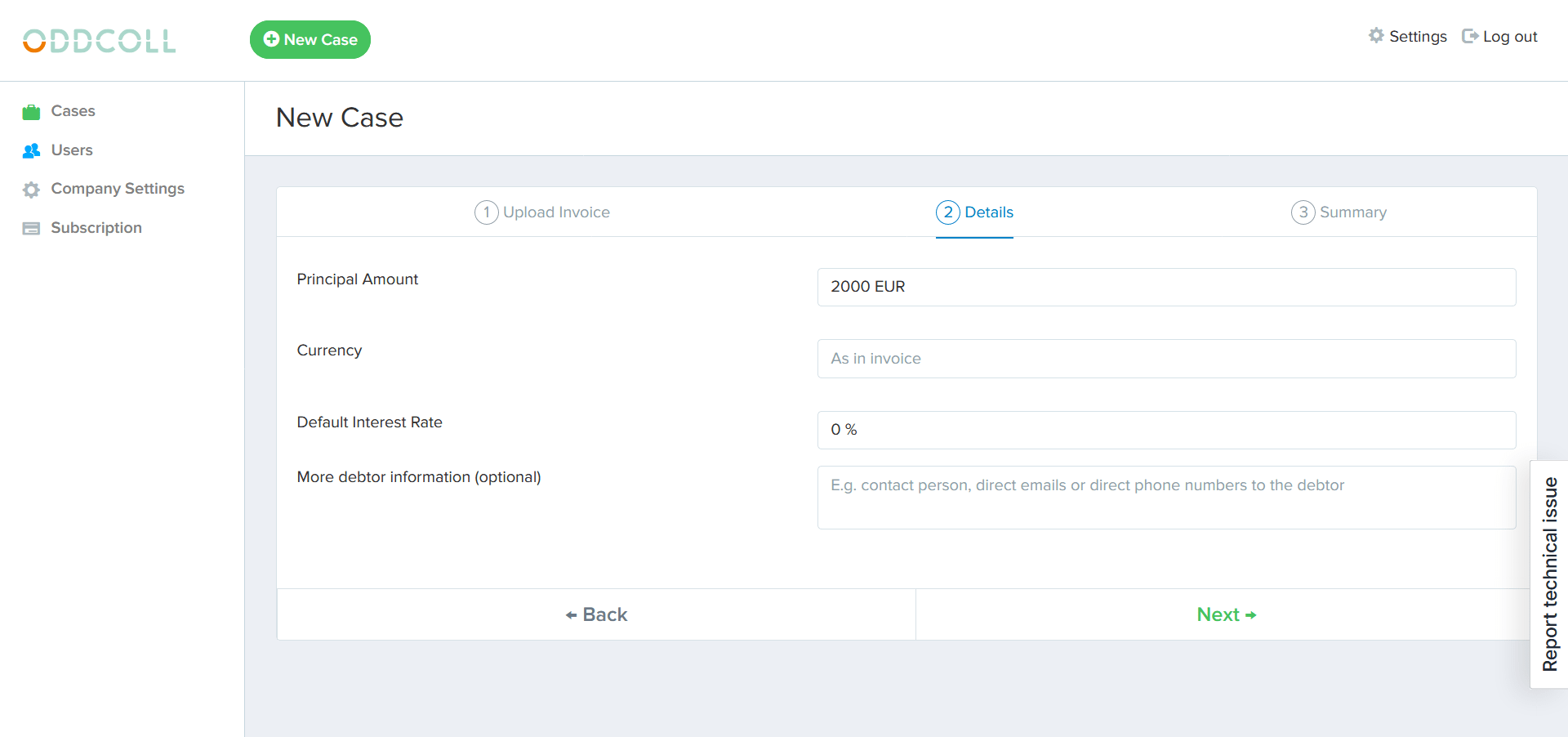
Three steps for you until you get paid by your Italian client.
Easily upload your unpaid invoices against your Italian debtors on our debt collection platform.
Our local Italian debt collection agency starts the activities for debt collection in Italy.
Once our Italian debt collection agency has got the debtor to pay, the money is transferred to you.
Advantages of our debt collection in Italy.
Professional debt collection specialists on site in Italy to collect your unpaid invoices.
Experts in Italian legislation for the recovery of debts.
Well versed in the Italian business culture.
How we can help you!
Oddcoll is an online platform with top notch debt collection agencies and professional law firms worldwide. We make debt collection in Italy effective through our native expertise and risk free methodology. This is why organizations with foreign sales love to utilize Oddcoll.
To deal with our debt collection claims against debtors in Italy, we have hand-picked Italian debt collection agencies. We presently just work with PN Italia, due to their consistently high level of debt recovery and customer satisfaction.
Our debt collection agency in Italy.
When you sell goods or services to Italian companies, keep in mind that they have among the longest payment terms for B2B invoices in Europe. But when the invoice is due and you cannot get the Italian debtor to pay, you should use a professional Italian debt collection agency to recover your invoice.
Our debt collection agency in Italy, PN.Italia, is ready to start processing your claims as soon as you have uploaded them to our debt collection platform.
Introduce your company in a few sentences?
PN ITALIA is a debt collection agency in Italy with specialists in the debt collection sector, with more than 20 years of experience. We work the claims with competence, maximum attention and great professionalism, facing all challenges with enthusiasm. We manage both b2b and b2c claims for any kind of sector and size.
How often do you get paid in your cases?
We have a success rate of around 90% for our Italian debt collection cases.
Describe the debt collection process (out of court). What do you do in order to get a debtor to pay, step by step?
In addition to the identification and investigation, our activity concentrates on tracking, notification via written requests, telephone contacts and possible home collection. We also proceed in a second step with the sending of the reminder issued and signed by our specialized legalists, considerably increasing the pressure on the debtor and the attitude towards paying the debt.
What are the cost of legal action?
Costs of legal action are different in case lawyer can made an Injunction (Simple Procedure) or in case is necessary start with an Ordinary Process.
If you take legal actions in a case and win in court, are you able to always add the legal costs that the client has paid to the debt and it will be paid by the debtor?
Only the Judge in his sentence could establish if the part that loose the lawsuit has to pay all the costs, generally the part that lose the lawsuit is judged to pay the costs.
“Judicial” debt collection in Italy
Our Italian debt collection agency will do its best to get your debtor to pay. However, sometimes legal action may be required, in which case it is in Italy that legal action should be taken. In any case, you need not worry. We are specialists in this too.
Which court should you turn to in order to recover your Italian debt?
The basic guideline is that the competent court is the court where the defendant lives (or where a company has its headquarters). This is the guideline for regional jurisdiction and is what is laid down in what is described as the common forum of ordinary people (foro generale delle persone fisiche).
Depending on the amount in dispute, or on the particular issue at stake, you may sometimes need to go to a specific court.
The application should be addressed to the other party and sent to the court clerk’s office. The application should almost always be submitted in writing in Italian.
Would I be able to bring a court action without help from anyone else or do I need an attorney?
In almost all civil cases in Italian courts, you need to have a legal representative. Exceptions are made for very small claims.
Will I need to pay court charges?
Yes, there is a charge for initiating a court case in Italy. The cost depends on the size of the claim and is paid to the authorities. Lawyers’ fees also apply and are based on the contract with the legal representative.
Order for Payment Procedure:
As in most nations, there is a special legal procedure that can be utilized for legal debt collection in Italy.
In order to use this procedure in the Italian legal debt collection process, it is required that the claim has not been contested by the debtor beforehand. In addition, the claim must be fixed at a specific amount and there must be written proof of the existence of the claim.
If the court hearing the case considers the application to be complete, it orders the debtor to pay the full amount within a certain period of time, usually 40 days.
In the same injunction, the court will also inform the defendant that he can contest the order within the same period of time.
If no objection is made, the order for payment will be considered final and can be enforced.
The order for payment can be used for all cases of debt collection in Italy. In other words, there is no limit to the amount.
The application: the application for an order for payment in Italy must contain the claim and the facts supporting the claim. However, the circumstances do not have to be described in detail but only as a summary.
When the court acknowledges an application, and gives an order for payment, that order should be served on the defendant. In Italy it should be served inside 60 days of the decision, contrasted with 90 days whenever served outside Italy.
After getting the order for payment, the defendent has 40 days to challenge the case. An objection means that ordinary court proceedings are started in which the court examines the merits of the case.
If an objection is not lodged within the timefram, the court which notified the order for payment will declare that it is enforceable on the petitioner’s application.
The competent court for the order for payment procedure: an application for an order for payment must be made to a justice of the peace (giudice di pace) or to the general court (tribunale) that would have jurisdiction in standard procedures. The justice of the peace is skilled to hear just small cases in the court.
Judicial enforcement of an Italian claim.
Once you have obtained a judgment, either through the normal legal procedure or through an order for payment, you expect the debtor to pay the debt.
If this does not happen, you as a creditor may have to apply for enforcement. This can be said to be the last step in the legal recovery of debts in Italy.
The ordinary courts are the public bodies competent to examine and carry out enforcement.
A necessary condition for initiating enforcement is that the creditor has an enforcement order. This is usually a judgment from previous legal proceedings.
Insolvency proceedings in Italy.
From time to time, organisations find themselves in financial difficulties and unable to pay their debts. In such cases, bankruptcy proceedings may be necessary. This is also the case in Italy.
Bankruptcy proceedings can be initiated against companies on the grounds that they either have:
(a) assets and resources of at least €300,000 in the three years preceding the application for insolvency or composition.
(b) annual net income of €200,000.00 or more in each of the three years preceding the application for insolvency or arrangement.
c) Total debts (on the date of the application for insolvency or arrangement) of the following amounts.
EUR 500,000.00 or more.
The assets of the insolvent company are gathered in a bankruptcy estate. This is to ensure that all claims are dealt with fairly. A liquidator takes over the management of the assets.
Do you need help with debt collection in Italy? Our Italian specialists and debt recovery experts are eager to help you deal with your payment problems. Do not hesitate to contact us for more information about our efficient debt collection services in Italy.
See how easy it is to get started with your case!
We make it easy for companies to get paid from their customers abroad.